
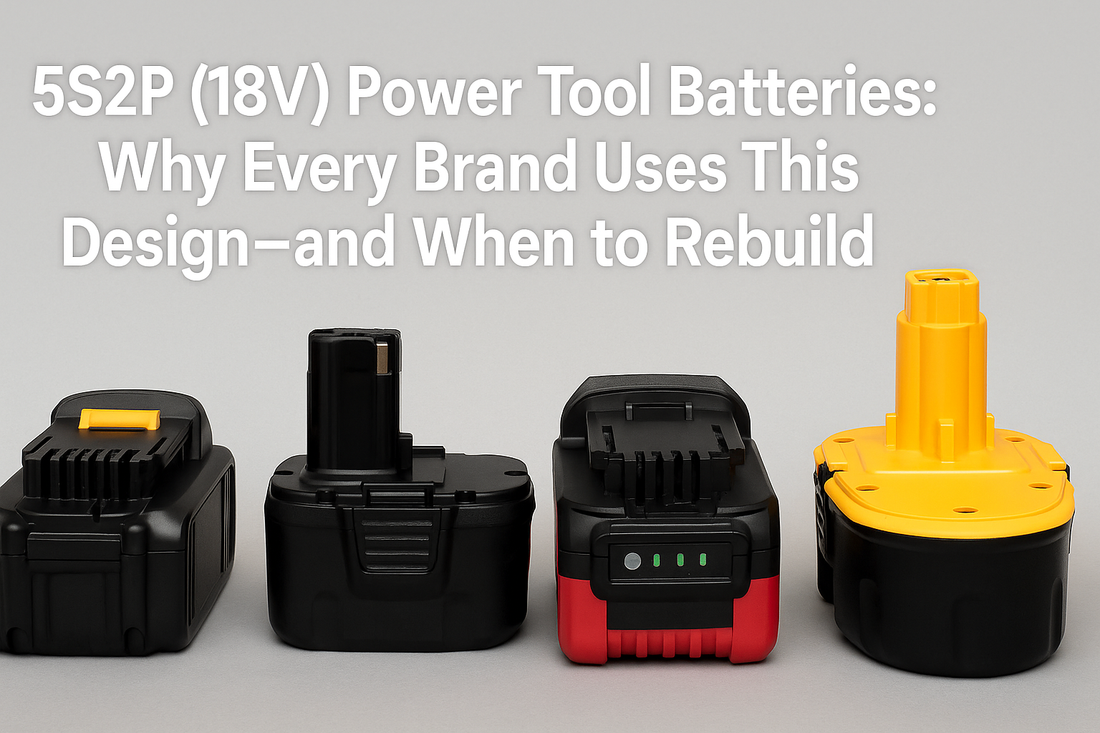
5S2P (18V) Power Tool Batteries: Why Every Brand Uses This Design—and When to Rebuild
Open almost any 18V tool battery and you’ll find the same layout: 5S2P—five cells in series, two in parallel. That gives a nominal 18V (21V full charge) with enough current for drills, grinders, and saws, without making the pack bulky or heavy.
Why 5S2P is the “goldilocks” design
- Voltage sweet spot: 5 cells in series hit ~18V nominal—ideal for efficient tool motors and electronics.
- Current on tap: 2 cells in parallel share load and heat, enabling high bursts without sag.
- Runtime vs. weight: 10 cells total give solid capacity while keeping packs compact for one-hand use.
- Thermal management: Parallel pairs reduce stress on each cell, improving life under heavy loads.
- Ecosystem compatibility: The 18V class is industry-standard across brands and tools.
What’s inside a typical 5S2P pack
- 10 high-drain 18650 cells (often 20–30A per cell). Browse our 18650 cells.
- Protection/BMS board managing cell groups, temperature sensing, and pack I/O.
- Nickel bus bars and harnessing for series/parallel connections.
- Insulation & structure: fish paper rings, fish paper sheet, Kapton tape, and heat-resistant housings.
Why packs fail—and why rebuilds make sense
Cells wear out long before the case and electronics. A pack that won’t hold charge or sags under load often just needs new cells. Replacing the 10 cells with fresh, matched, high-drain units restores power and runtime—usually for half the cost of a new OEM pack.
5S2P rebuild kits we stock
Each kit is a complete matched set — 5S BMS, housing, nickel and hardware — with cells supplied separately so you choose your own. All are the 5S2P layout described above.
| Platform | SKU | Price |
|---|---|---|
| DeWalt DCB205 20V | KT101 | $29.99 |
| Milwaukee M18 18V, 10-cell | KT102 | $21.99 |
| Ryobi 18V | KT106 | $31.99 |
| RIDGID 18V | KT104 | $47.07 |
| Bosch-Style 18V | KT103 | $29.19 |
| Makita 18V LXT, 10-cell | KT111 | $17.99 |

You supply the cells. Ten of these build a 5.0Ah pack at the factory spec:

How the rebuild goes
- Open and diagnose: probe each of the five groups. One group well below the rest is the classic signature of a worn pack.
- Fit the new cells: matched, high-drain, insulator rings on every positive end.
- Spot weld: pure nickel to the 5S2P layout, two pulses per joint, tug-test each one. Never solder directly to a cell can.
- Wire the BMS: B0 first, then B1–B5 in ascending order, and confirm the voltage ladder before seating the connector.
- Charge and verify: a completed pack should read ~21.0V, with all five groups within 0.03V of each other.
Full walkthroughs: the DeWalt DCB205 guide and the Snap-on 18V guide — same layout, two different platforms.
Safety first: Lithium-ion packs can short or vent if mishandled. Wear cut-resistant gloves and use precision cutters. If your BMS is damaged or the case is cracked, don’t rebuild it — recycle the pack.
FAQs
Why not 20V or 24V?
“20V max” marketing typically refers to the same 5S pack at full charge (~21V). 24V designs exist, but 18V/20V-max is the broadest ecosystem with the best tool selection.
Can I upgrade capacity?
Yes—using cells with higher mAh can extend runtime, but the cells must still be high-drain to handle tool loads. Balance capacity, current, and longevity rather than chasing the mAh number alone.
Is 21700 better than 18650 for tools?
Some newer platforms do use 21700 for more capacity per cell. Many 18V packs remain on 18650 for size/weight and compatibility. The formats are not interchangeable, so rebuild in whatever your pack was designed around. Either way, cell quality matters more than format — see our 21700 vs 18650 comparison.
Rebuild supplies we stock


Related Reading
- How to rebuild a DeWalt DCB205 20V MAX pack (5S2P, step by step)
- Rebuilding a Snap-on 18V pack (same 5S2P layout)
- Power tool battery cell guide: what each brand uses
- What nickel strip size do you need?
- Why rebuilding tool batteries beats buying new
Browse the full rebuild kit range and battery parts at RenewSpark.


