
21700 vs 18650 Batteries: Key Differences, Advantages, and When to Use Each
Wondering whether to choose 21700 or 18650 cells for your next project? Both are widely used lithium-ion formats—but they serve different needs. In this guide, we’ll compare the two so you know exactly when to use each.
What are 18650 and 21700 cells?
Both refer to cylindrical lithium-ion cells. The numbers are dimensions:
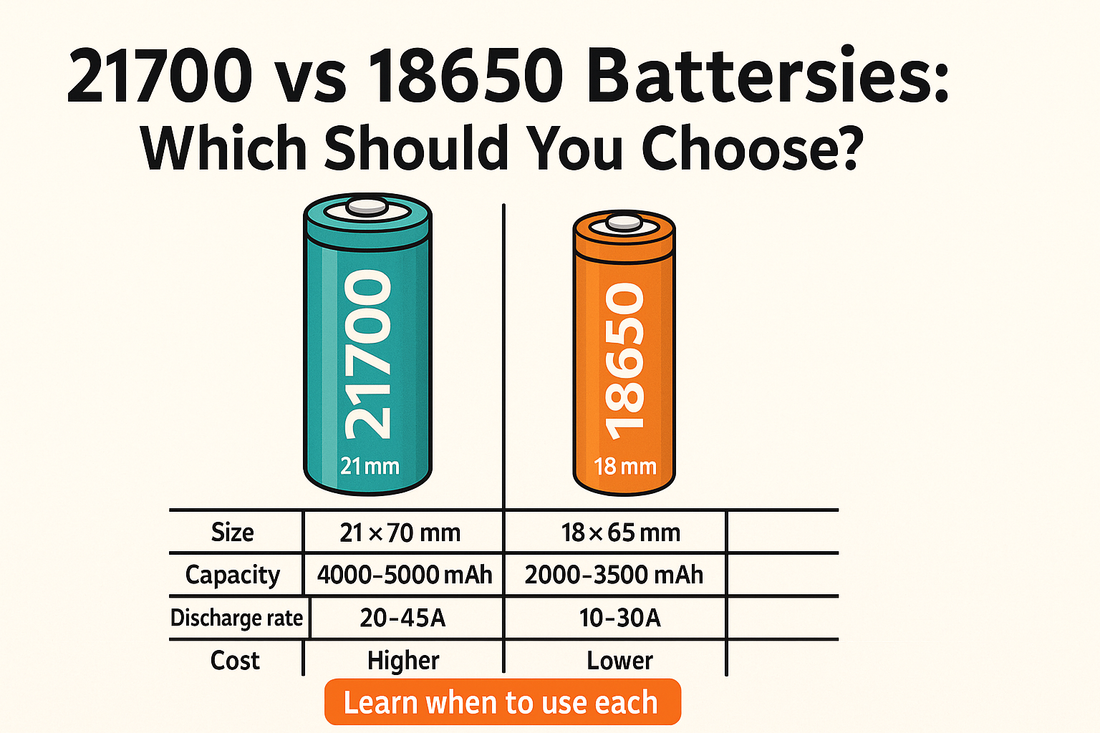
- 18650: 18 mm diameter × 65 mm length
- 21700: 21 mm diameter × 70 mm length
That extra size in a 21700 allows more active material, leading to higher capacity and better current handling. Browse our 18650 cells and 21700 cells.
The formats are not interchangeable. A 21700 will not fit a pack designed around 18650 cells, and vice versa — the difference is 3 mm of diameter and 5 mm of length per cell, which no amount of rewiring solves. Confirm what your pack uses before ordering.
Key differences
| Feature | 18650 | 21700 |
|---|---|---|
| Size | 18 × 65 mm | 21 × 70 mm |
| Capacity range | 2000–3500 mAh | 3500–5000 mAh |
| Energy density | Lower per cell | Higher per cell |
| Current handling | 20–30A (high-drain models) | 30–45A (e.g. P42A) |
| Cost per cell | Cheaper | More expensive |
| Weight | ~45 g | ~65–70 g |
When to use 18650 cells
- Rebuilding power tool packs (like Snap-on CTB8185, Makita, DeWalt)
- Compact DIY packs (2S1P, 3S1P, etc.) where space is tight
- Projects where lower cost is important
- Light to medium duty applications

Pair them with fish paper rings, heat shrink, and quality pure nickel strip for safe assembly.
When to use 21700 cells
- E-bike or scooter packs where higher capacity extends range
- High-drain builds (30A+ continuous discharge)
- Heavy-duty tool packs that need maximum runtime
- Applications where fewer cells simplify the pack design
A pack built with Molicel P42A 21700 cells, sturdy cell spacers, and a solid BMS board can deliver exceptional performance and longevity.
Which should you choose?
If you’re rebuilding tool batteries on a budget, 18650 cells are tried and true. For performance and efficiency, especially in larger packs, 21700 cells are the new standard. Many modern EVs and premium tools now use 21700 for their energy density and current handling.
In practice the choice is usually made for you: rebuild the pack you have, in the format it was designed around. The 18650-versus-21700 decision is a real one only when you are designing a pack from scratch.
Recommended parts


Related Reading
- Power tool battery cell guide: what each brand uses
- How to tell whether a used cell is still good
- What nickel strip size do you need?
- Do you need cell spacers for 18650/21700 packs?
- Why every 18V brand uses the 5S2P layout
Tools you may also need: spot welder and internal resistance tester.
Safety tip: Always wear cut-resistant gloves and precision cutters when working with cells. Lithium-ion packs can short or vent if mishandled.
Ready to upgrade your builds? Shop RenewSpark for tested cells, spacers, and rebuild supplies today.


