
How to Choose the Right Lithium-Ion Battery Pack
Looking for a battery pack for your RC build, FPV goggles, or DIY electronics? Here’s what to know before you buy.
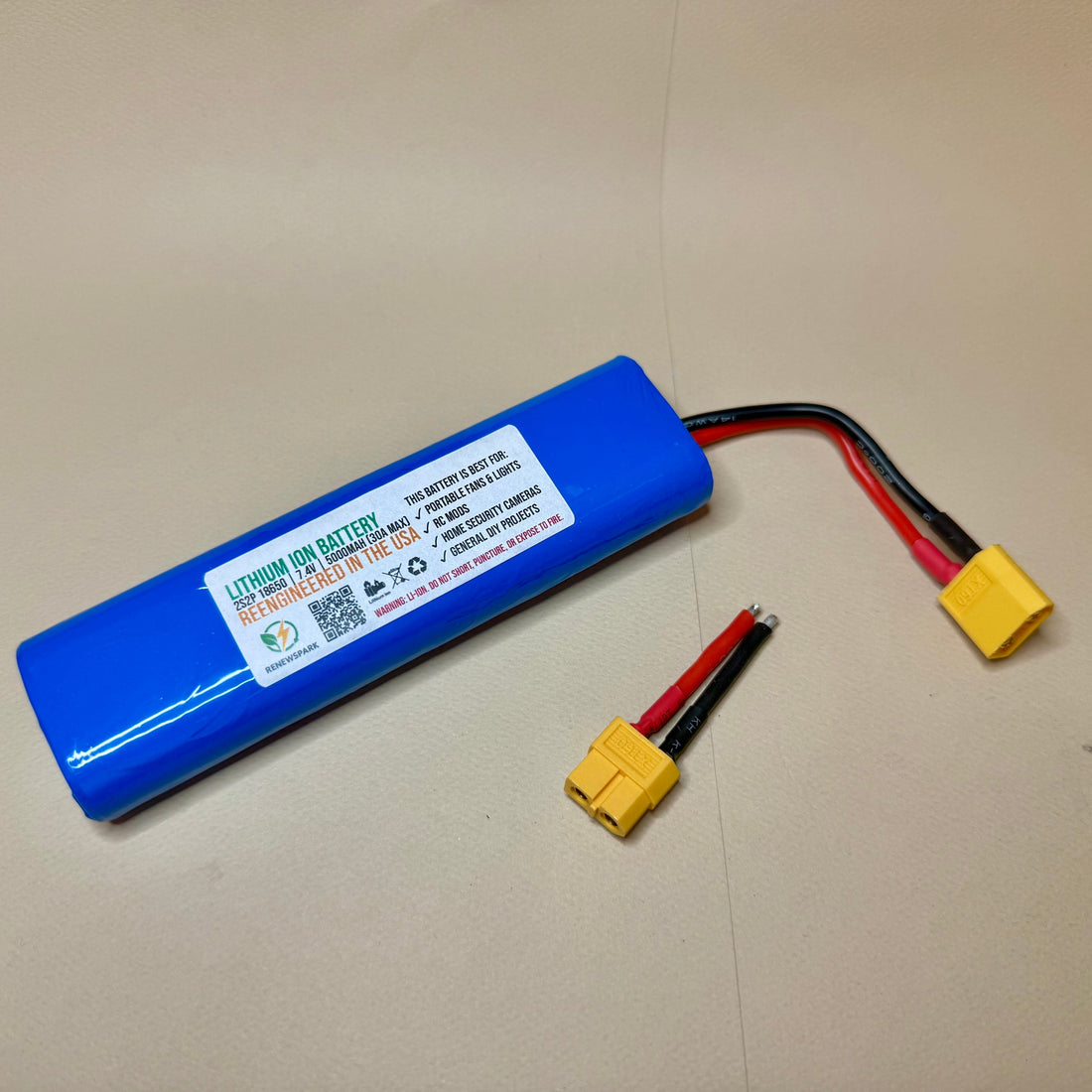
Lithium-ion battery packs are a great choice for DIY projects because they’re lightweight, rechargeable, and offer high energy density. But with so many options — 18650 vs 21700, 2S1P vs 2S2P — how do you choose?
Understand your power needs
- Voltage: Most RC and portable devices run on 7.4V (2S). If you’re powering fans, LED strips, or Arduino setups, a 2S pack is usually enough.
- Capacity: Measured in mAh. A 2500mAh pack lasts a shorter time than a 5000mAh one but may be smaller and lighter.
- Current draw: Look for cells rated for higher amps (20A, 30A, 40A) if you’re powering motors or tools.
Voltage and current are set by how you wire the pack. Capacity comes from the cells you choose. Get the first two right and the third is just a budget decision.
Battery cell types
- 18650 cells: Popular for compact builds and lower current applications.
- 21700 cells: Bigger, more powerful — great for longer run times or higher loads.
The two formats are not interchangeable: a 21700 is 3 mm wider and 5 mm longer, so a pack designed around one will not take the other. Our 21700 vs 18650 comparison works through which to pick when you’re designing from scratch.


2S1P or 2S2P?
Both give you 7.4V nominal. The difference is what sits in parallel:
- 2S1P — two cells, one per series group. Capacity equals a single cell. Smallest and lightest option, fine for light loads.
- 2S2P — four cells, two per group. Double the capacity and double the current headroom, at double the size and weight.
We have step-by-step guides for both: building a 2S1P 7.4V 21700 pack and building a 2S2P 7.4V 21700 pack. Each lists the full bill of materials.
Don’t skip the BMS
A protection board guards against over-charge, over-discharge, and short circuit, and keeps the series groups balanced. On a 2S pack it is a few dollars and it is not optional — an unprotected lithium pack is the one that makes the news.

Not sure what rating you need? Our BMS sizing guide works through it, and the 2S BMS troubleshooting guide covers wiring the board above.
Finish it properly
The parts that get skipped are the ones that cause failures later: fish paper on the positive ends, a sheet between the cell stack and the board, and a connector matched to your current.

Sizing the connector to the pack matters — see XT30 vs XT60 vs XT90. Browse the rest in conductive strips and insulation.
Building it yourself
At RenewSpark we supply the cells, boards, nickel, insulation and connectors to build a pack properly — shipped from California, with guides for the common configurations. Whether you’re building a robot, modding a tool, or powering a mobile camera setup, start from the guide that matches your layout and work through its parts list.


